
UND1658: high-capacity B2ca fibre optical cable for data centre interconnections
_________________________________________________________________________________________________________________________
Meeting the new challenges of data centre interconnections

The exponential growth of cloud and AI-driven digital uses is driving a rapid increase in data centre interconnections (DCI).
These critical infrastructures impose stringent requirements: high capacity, reliability, fire safety and ease of deployment.
In increasingly dense and hybrid (indoor/outdoor) environments, operators are looking to simplify architectures while ensuring service continuity and regulatory compliance.
Against this backdrop, ACOME Group has designed the new UND1658 range, dedicated to data centre interconnections, combining high capacity with excellent fire performance (B2ca).
A solution designed for data centre interconnections
The UND1658 range has been specifically developed to meet the constraints of modern DCI infrastructures.
Simplified installation to accelerate deployments
- Suitable for duct installations: pulling, blowing or water-assisted installation
- Facilitates deployment in complex environments, i.e. faster time-to-market
- Compatible with existing network architectures
It helps accelerate and secure deployments while keeping infrastructure costs under control.
Capacity tailored to the growing needs of data center
Designed for growing bandwidth requirements, the range offers:
- Capacities from 72 to 864 fibres
- An intelligent design using 12-fibre modules for easier handling and more efficient field management
- High density while maintaining a controlled cable diameter
Technical features designed for performance and durability
The UND1658 range incorporates technical features that ensure performance and durability:
- Dielectric construction
- Dry water-blocking
- UV resistance for outdoor use
- Excellent mechanical strength (tensile and crush resistance)
- An optimised Compact Tube® architecture, providing quick, tool-free fibre access and easy preparation (mid-span or cable end)
- Simplified identification of fibres and modules
- Wide operating temperature range (-30°C to +70°C)
A versatile solution for indoor/outdoor networks
Thanks to its flame-retardant LSZH sheath, the cable can be used both indoors and outdoors, with no transition box required.
This cable range simplifies network architecture, reduces potential failure points, saves deployment time and lowers installation costs.
Excellent fire performance for critical environments
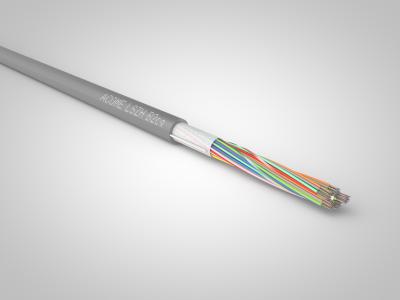
Fire safety is a major concern in data centres and technical buildings.
The UND1658 range features an LSZH-FR (Low Smoke Zero Halogen – Flame Retardant) sheath delivering very good fire performance and complies with CPR requirements with a B2ca classification. Declarations of Performance (DoP) are available on our website.
The UND1658 range directly addresses:
- The need for greater DCI network density
- The constraints of mixed indoor/outdoor environments
- Fire safety and regulatory compliance requirements
- The need for solutions that optimise overall deployment costs
Field feedback on data centre interconnections
A solution already adopted for the most demanding DCI infrastructures
The performance of the UND1658 range is recognised by major players in Europe’s digital infrastructure sector.
“One of the leading installers working on DE-CIX in Frankfurt, Europe’s largest Internet Exchange, favours ACOME cables for data centre interconnections for several key reasons:
• Availability of capacities up to 864 fibres with a CPR B2ca classification, enabling their use as connection cables to all data centres in Frankfurt;
• Consistent design between PE-sheathed outdoor cables and LSZH-sheathed connection cables, simplifying splicing in standard splice closures;
• Particularly flexible Compact Tubes, simplifying installation in confined spaces and the storage of spare lengths in splice closures;
• Modular architecture in groups of 12 fibres, perfectly suited to standard splice trays and fibre routing in connection enclosures.”
A concrete environmental commitment
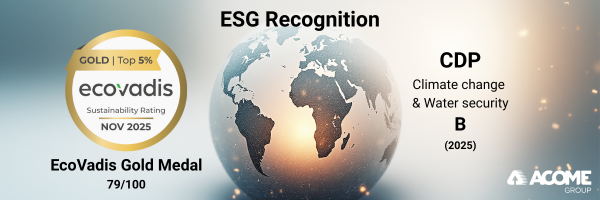
ACOME is strongly committed to environmental issues, as demonstrated by its EcoVadis Gold certification (placing the company in the top 5% of its sector), its excellent CDP (Carbon Disclosure Project) ratings, and the validation of its carbon-emission reduction targets by the SBTi initiative.
French manufacturing with a low carbon footprint
The UND1658 range is manufactured in France and therefore benefits from a low-carbon electricity mix, directly helping to reduce the carbon footprint of deployed infrastructures.
A transparent approach based on life-cycle assessment
As part of its commitment to transparency and continuous improvement, ACOME systematically carries out Life Cycle Assessments (LCA) on its optical cables. We can therefore provide, on request, an Environmental Product Declaration (EPD), enabling a precise assessment of the carbon impact across the entire life cycle.
Please contact us to obtain these documents and fully integrate the environmental dimension into your infrastructure projects.
With the UND1658 range, ACOME Group offers a solution perfectly suited to today’s data centre interconnection challenges :
pmore capacity, greater safety and simpler deployment, all in support of network performance.
Frequently asked questions about the UND1658 cable
What is the UND1658 fibre optic cable used for?
The UND1658 cable is designed for data centre interconnections. It provides an optical fibre link in ducts with a capacity ranging from 72 to 864 fibres and can run through both indoor and outdoor environments.
How can the UND1658 cable be installed?
The UND1658 cable is suitable for duct installation by pulling, blowing or water-assisted installation. Its dielectric construction, dry water-blocking and UV resistance facilitate use in complex infrastructures.
How many fibres are available in the UND1658 range?
The UND1658 range covers configurations from 72 to 864 fibres. The fibres are grouped into 12-fibre modules to make identification and management easier.
Which solution should I choose if my project does not require several hundred fibres?
The UND1658 range is particularly well suited to high-density DCI infrastructures, with capacities ranging from 72 to 864 fibres.
For projects requiring fewer fibres, such as local connections, interconnections between medium-sized data centres or certain Edge Data Center architectures, ACOME also offers the UND1636 range.
Available from 6 to 48 fibres, this indoor/outdoor solution also features a flame-retardant LSZH sheath and CPR Cca reaction-to-fire performance. It therefore retains the benefits of a single cable from outside to inside the building, while optimising network costs and dimensions when lower capacity is required.
From 6 to 864 fibres, the UND1636 and UND1658 ranges therefore provide a complete answer to data centre interconnection and DCI network requirements.
What is the fire classification of the UND1658 cable?
The LSZH-FR sheath of the UND1658 range complies with the CPR regulation with a B2ca classification. Declarations of Performance are publicly available on our website:
What types of optical fibre are available in the UND1658?
The UND1658 cable can be supplied with different single-mode fibres compliant with ITU-T recommendations, including G.652.D and G.657.A1/A2, depending on network needs and installation constraints.
In which environments can the UND1658 cable be used?
Thanks to its Indoor/Outdoor design, the UND1658 cable can be deployed in telecom chambers, underground ducts, technical buildings, data centres and interconnection points without changing cables between outdoor and indoor sections.
Why does the UND1658 not require a transition box?
Its sheath and design allow the same cable to be used both indoors and outdoors. Because there is no need to change cables between the two environments, the corresponding transition box can be eliminated.
What are the benefits of the cable’s dielectric design?
The absence of metallic elements makes the cable immune to electromagnetic interference, facilitates installation and reduces risks when installed near electrical equipment.
How does the UND1658 help reduce deployment costs?
Using a single cable between the outside and inside of the building reduces the number of components to install, eliminates transition boxes and simplifies installation and maintenance operations.
Is the UND1658 suitable for AI infrastructure and hyperscale data centres?
Yes. With up to 864 fibres in a compact cable, the UND1658 meets the growing connectivity requirements driven by artificial intelligence infrastructure, hyperscale cloud and high-performance computing (HPC).
Why choose the UND1658 cable for a data centre interconnection?
The UND1658 combines high fibre density, CPR B2ca compliance, an Indoor/Outdoor design with no transition, simplified installation and optimised dimensions. It enables data centre operators to reduce infrastructure complexity while meeting the capacity and safety requirements of new digital environments.
Access product information
Visit the ACOPTIC UND1658 product page to access technical specifications, available documents and the information you need for your data centre interconnection project.